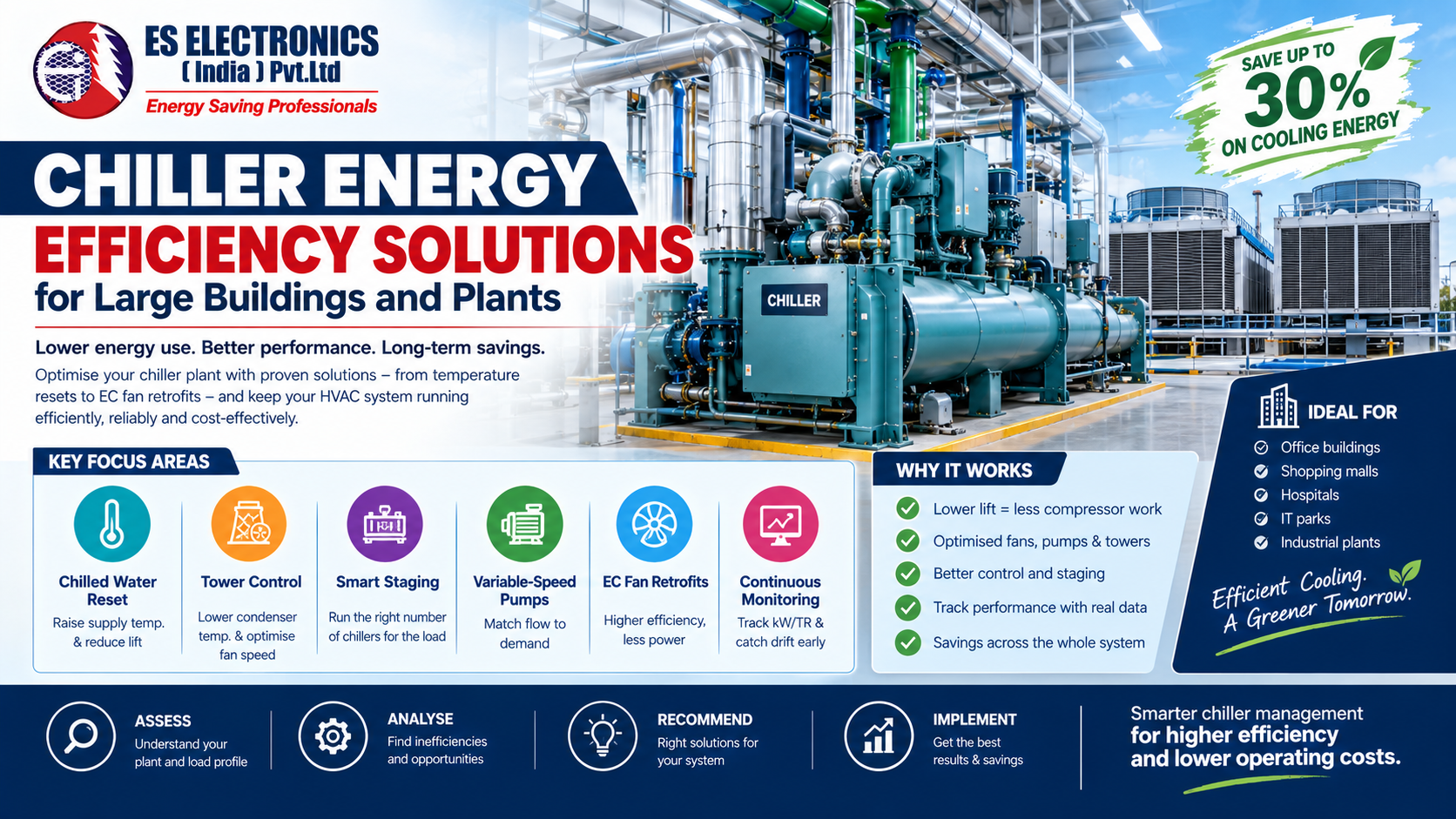
Cooling is often the biggest single line on the electricity bill of a hospital, mall, office park or process plant, and the chiller sits at the centre of it. Chiller energy efficiency solutions target that load directly. For the wider picture, see our range of energy saving products and solutions.
This guide covers six practical measures, from temperature resets to EC fan retrofits, with the trade-offs each one carries. It also shows how HVAC and chiller optimisation fits together as one plan, and where to start.
The Short Version
• Chiller efficiency depends mainly on lift, the gap between condenser and chilled water temperatures.
• Control changes cost least and should come first.
• Fans, pumps and towers matter as much as the chiller itself.
• Track kW/TR continuously, or savings drift away.
Where Does Chiller Plant Energy Actually Go?
In a water-cooled plant, electricity feeds four groups of equipment: chillers, chilled water pumps, condenser water pumps and cooling tower fans. Chiller energy efficiency solutions work best when you treat all four as one system rather than tuning each in isolation.
Chiller efficiency depends mainly on lift, the gap between leaving condenser water temperature and leaving chilled water temperature. A smaller gap means less compressor work for the same cooling.
Most measures below either shrink lift or cut the energy used by the equipment around the chiller. Large savings rarely come from one device. They come from many small corrections, such as better set points, staged equipment and fans that slow down when demand drops.
What Are The Six Best Ways To Improve Chiller Efficiency?
Six chiller energy efficiency solutions have the best track record: temperature reset, tower control, smart staging, variable-speed pumping, EC fan retrofits and continuous monitoring. Each suits different plants, so match the measure to your equipment.
| Measure | What it does | Where it works best | Watch out for |
|---|---|---|---|
| Chilled water reset | Raises supply temperature at light load to cut lift | Plants with variable load and modern controls | Coils that need cold water all year |
| Tower and condenser control | Lowers condenser water temperature and slows tower fans | Water-cooled plants | Minimum tower flow limits |
| Smart chiller staging | Runs the right number of chillers for load and lift | Multi-chiller plants | Surge when staging on load alone |
| Variable-speed pumping | Matches chilled water flow to demand | Primary-only systems | Condenser pumps need careful tuning |
| EC fan retrofits | Replaces old fans with efficient, speed-controlled ones | Ageing air handling units and cooling towers | Verify airflow after retrofit |
| Continuous monitoring | Tracks kW/TR and flags drift | Every plant | Sensors must be calibrated |
The control logic in the first four rows follows the strategies reviewed in Consulting-Specifying Engineer’s guide to chilled water plant performance, which also covers the energy code requirements for variable-speed pumping and reset controls.
How Does A Chilled Water Temperature Reset Save Energy?
Raising the chilled water supply temperature when cooling demand is light reduces lift, so the chiller works less for the same output. It is usually a control change rather than new hardware, which makes it a low-cost first step.
There is a trade-off. A warmer supply needs more flow to deliver the same cooling, so pumps use more energy. According to the same engineering review, the chiller saving typically outweighs the extra pump energy.
Check your coils first. Cooling coils respond more strongly to entering water temperature than to flow, so coils that serve constant high loads, such as technical rooms, must be sized for warmer water or they will block the reset.
An energy audit logs supply and return temperatures, flow and power together, so you can see how much reset room your plant really has.
How Should Cooling Towers, Pumps And Chillers Be Controlled?
Good chiller energy efficiency solutions control towers, pumps and chillers together. Run as many towers as allowed at lower fan speed, stage chillers by load and lift, and use variable-speed pumps with care.
• Towers: more towers at lower speed give more heat-transfer area, and fan energy falls steeply with speed. Respect the maker’s minimum flow, typically 40% to 50%.
• Chiller staging: variable-speed chillers run most efficiently with the maximum number of units at low load. Staging on load alone can push centrifugal chillers into surge.
• Chilled water pumps: speed control holds a differential pressure setpoint as demand falls, and the prescriptive path of ASHRAE 90.1 requires it.
• Condenser water pumps: less clear-cut. Slowing them cuts pump and tower energy but can raise chiller energy through higher lift.
The review notes that ASHRAE guidance favours constant-speed condenser pumps with variable tower fan speed, though the topic remains debated. Test any change against measured plant kW/TR before you adopt it.
Do You Need An Expensive Optimisation Package?
Often not. Well-programmed standard control sequences can land within a few percentage points of best-case plant efficiency, so a costly third-party package may add little to a new plant. Older plants without modern controls are different.
Before you buy chiller energy efficiency solutions packaged as software, ask what baseline the savings claim uses. The review points out that vendor paybacks of five years or less rest on assumptions about that baseline.
A fair test compares the package with a modern standard sequence, not with today’s settings. For plants with old controls, packages can still pay, but the cost of engineers, sensors, drives and commissioning for a DIY route can exceed the package price, so price both.
Where Do EC Fan Retrofits Fit In?
EC fan retrofits replace old fans on air handling units and cooling towers with efficient fans whose speed follows demand. They cover the airside and tower side of HVAC energy optimisation, where chiller controls cannot reach.
ES Electronics’ EC fan retrofits for air handling units and cooling towers can cut HVAC energy by up to 50%, with actual results depending on load, running hours and the equipment you start with.
Field results support the approach. Fan maker ebm-papst reports that an IT services company in India cut energy use by about 30% after replacing more than 1,000 fans across eight sites. That figure covers the whole programme and comes from the manufacturer, so treat it as an indication.
Pair fan retrofits with sensible controls. Fans that slow down when demand falls only save energy if set points, dampers and coil valves let them. Test airflow and room conditions after each retrofit, and expand to more units only once results hold.
How Do You Measure And Hold On To The Savings?
Track plant efficiency as kilowatts per tonne of refrigeration (kW/TR) for the whole plant, including chillers, towers and pumps. Trend it against load and outdoor wet-bulb temperature so you can spot drift early.
Of all the chiller energy efficiency solutions, monitoring is the one that protects the rest. A good reset or staging sequence loses value quietly when sensors drift, valves stick or operators switch automation off.
IoT-based energy monitoring shows kilowatt-hours by equipment and raises alerts on drifting set points, so a fouled condenser or an overridden reset shows up within hours rather than at the next bill.
The engineering review warns that optimised set points often fall victim to operator override. Give operators a clear graphic of how each reset works, and treat HVAC optimisation as a routine, not a one-time project.
What Is The Right Order To Start?
Start chiller energy efficiency solutions with a measured baseline, then work from low-cost control changes toward hardware retrofits. This order captures the cheapest savings first and shows what any bigger spend must achieve.
1. Measure: log chilled and condenser water temperatures, flow and power across typical load conditions.
2. Fix basics: calibrate sensors, clean tubes and repair valves and controls.
3. Tune controls: apply reset, staging and tower fan control.
4. Retrofit: add EC fans, drives or other hardware where payback is clear.
5. Monitor: review kW/TR monthly and investigate any drift.
Frequently Asked Questions
Which chiller energy efficiency solutions pay back fastest?
Control changes such as temperature reset and staging usually cost least, so they pay back fastest. Hardware like EC fans costs more but saves energy in every hour the system runs.
How much can HVAC optimisation save?
It depends on plant age, controls and load profile. ES Electronics quotes up to 50% on HVAC energy for EC fan retrofits, and an audit gives a plant-specific estimate.
Should we replace the chiller or optimise it first?
Optimise first. A measured audit shows whether control and fan measures deliver the savings you need before you commit to a new chiller.
Will a warmer chilled water supply hurt comfort?
Not if coils are sized for it. Check that coils serving critical areas can deliver design cooling at warmer water before you enable a reset.
Do upgrades need downtime?
Control changes need little or none, and most retrofits can be done unit by unit with minimal downtime. Replacing a chiller itself needs a planned changeover.
What data should we prepare?
Share chiller nameplates, 12 months of electricity bills, operating schedules, trend logs and any building management system screenshots. Better data sharpens the estimate.
What Should You Do Next?
Book a baseline study with a team that treats chiller energy efficiency solutions as one plant, not separate parts. Our team works Monday to Saturday, 9:30 AM to 6:30 PM, so contact ES Electronics for a free consultation and share your chiller details.